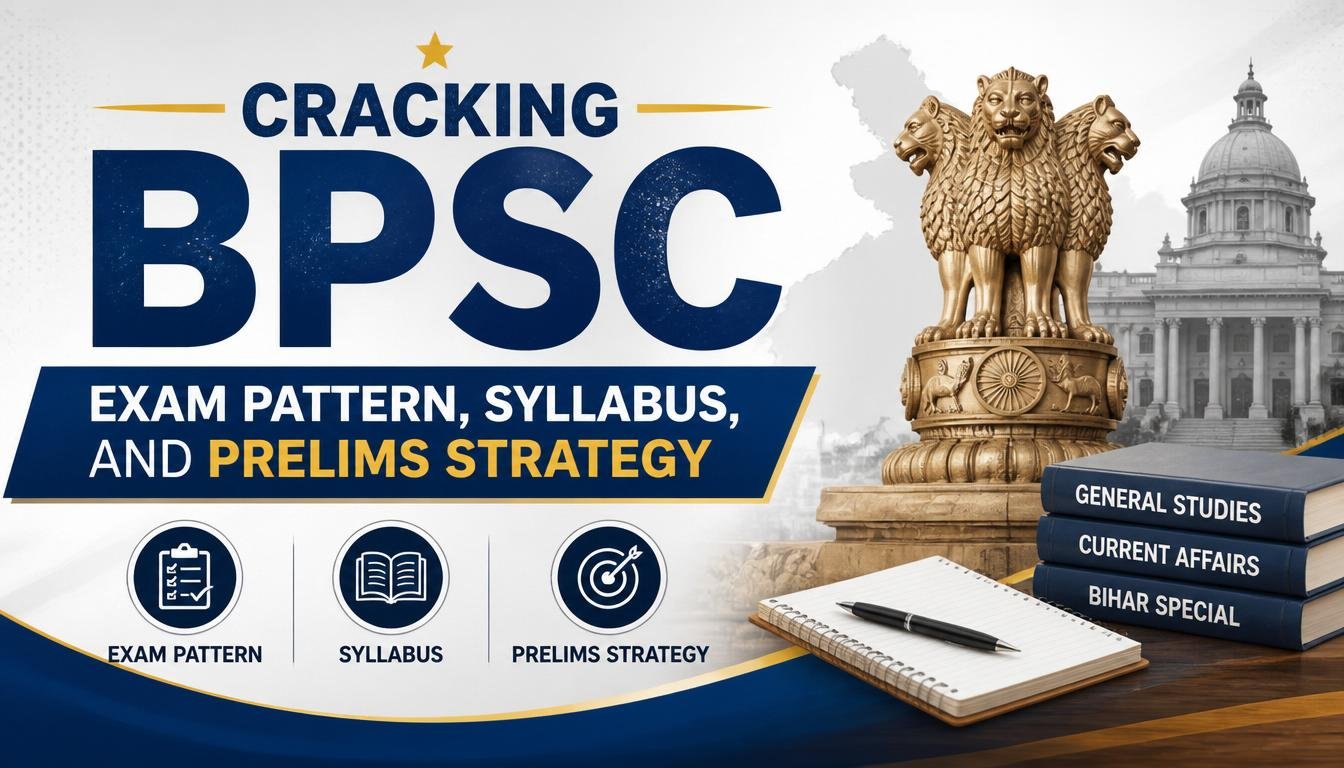
Here is a comprehensive, highly structured, and expanded version of the BPSC Combined Competitive Examination (CCE) guide. The content has been organized into clear, scannable sections with enhanced details on eligibility, exam strategy, and structural breakdowns.
The Ultimate Guide to BPSC CCE: Structure, Strategy, and Civil Services Career Path
The Bihar Public Service Commission (BPSC) Combined Competitive Examination (CCE) is the premier administrative gateway in the state of Bihar. Cracking this highly competitive exam appoints candidates to elite gazetted officer positions, including Sub-Divisional Magistrates (SDM), Deputy Superintendents of Police (DSP), Assistant Commissioners of State Taxes, and Rural Development Officers.
Given the immense prestige and responsibility associated with these roles, the commission has evolved its testing standards. Today, success demands a sophisticated approach that shifts away from rote learning toward analytical depth, conceptual clarity, and structured answer writing.
1. The Three-Tier Examination Architecture
The BPSC CCE is structured across three progressive stages. Each tier is engineered to thoroughly evaluate an aspirant’s intellectual capacity, factual retention, analytical depth, and overall personality alignment for a demanding career in public administration.
2. Deconstructing the BPSC Mains Syllabus Layout
The written merit of the BPSC CCE depends entirely on the descriptive Mains stage. The curriculum is balanced between mandatory qualifying papers and high-yield, competitive scoring components that total 900 marks for final evaluation.
Mandatory Qualifying Components (Non-Merit)
Before your core competitive papers are even graded, you must clear two structural filters:
-
General Hindi: 100 Marks (3-hour duration). Tests baseline descriptive proficiency in grammar, essay writing, summarization, and syntax. Candidates must secure a minimum qualifying threshold of 30% (30 marks).
-
Optional Subject Paper: 100 Marks. Conducted completely as an objective MCQ-based test tailored to the candidate’s chosen academic discipline. Candidates must achieve minimum passing marks based on their category (ranging from 30% to 40%).
Core Merit-Ranking Papers (900 Marks Total)
┌────────────────────────────────────────────────────────┐
│               BPSC MAINS MERIT SCORE                   │
├───────────────────┬───────────────────┬────────────────┤
│ General Studies I │─ General Studies II ─── Essay Paper│
│     300 Marks     │     300 Marks     │   300 Marks    │
└───────────────────┴───────────────────┴────────────────┘
1. General Studies I (300 Marks)
This paper balances historical analysis with data-driven reasoning. It is divided into three distinct segments:
-
Modern Indian History & Indian Culture: Focuses heavily on the mid-19th century onward, tracing the expansion of British rule and the architectural traditions of Bihar (such as Maurya, Pal, and Patna Kalam art styles).
-
National & International Current Events: Analytical questions tracing contemporary geopolitical shifts, multilateral summits, bilateral relations, and global socio-economic policies.
-
Statistical Analysis, Graphs & Diagrams: A high-scoring section testing your capability to interpret data matrices, pie charts, and line graphs. Precision here often bridges the gap to a top rank.
2. General Studies II (300 Marks)
Applied Governance, Developmental Economics, and Science Applications
This specific paper evaluates your knowledge of public administration, economic growth models, and practical technological deployments through three primary segments:
-
Indian Polity: This segment offers a detailed exploration of constitutional machinery, federal dynamics, and judicial review. Furthermore, it analyzes the electoral ecosystem alongside the specific executive execution of governance within Bihar.
-
Indian Economy & Geography of India: Examiners use this section to evaluate agricultural systems, industrialization, planning models, and resource distribution. Consequently, the paper places a massive emphasis on the socio-economic geography and modern budgetary priorities of Bihar.
-
Role & Impact of Science and Technology: This section focuses on how modern technological interventions can solve regional administrative crises. For instance, candidates must explain how tools like space technology, renewable energy, AI, and biotechnology address flood management, agricultural distress, and regional connectivity issues.
3. The Essay Paper (300 Marks)
The commission introduced this paper specifically to evaluate a candidate’s structured thought patterns, originality, and overall worldview. To achieve a high score, candidates must write three comprehensive, long-form essays worth 100 marks each across three distinct sections.
The Bihar Special Factor: Section III of the Essay paper focuses entirely on Bihar-centric culture, regional proverbs, and unique socio-economic realities. Therefore, mastering local Maithili, Bhojpuri, or Magahi idioms will give you a significant competitive edge.
3. High-Yield Strategy to Ace BPSC Prelims
The preliminary exam acts as a ruthless filter where lakhs of aspirants compete for a limited pool of seats. However, you can clear the cut-off comfortably by centering your preparation on four foundational pillars. Together, these core areas historically account for over 70% of the entire 150-mark question paper.
Pillar 1: History and Indian Culture (~30-35 Questions)
To build a strong foundation, read standard NCERT textbooks for Classes 11 and 12 thoroughly. In addition, supplement your reading with trusted reference guides like Spectrum (Modern History) or Lucent’s General Knowledge.
During your revision cycles, prioritize the Indian National Movement spanning from 1857 to 1947. You should drill down into Bihar’s revolutionary contributions, including the 1857 uprising led by Babu Kunwar Singh and the Champaran Satyagraha of 1917. Similarly, focus on the Kisan Sabha movements spearheaded by Swami Sahajanand Saraswati, alongside local underground resistance networks during the Quit India Movement.
Pillar 2: Current Affairs (~30 Questions)
Establish a habit of daily reading using a standard national newspaper like The Hindu or The Indian Express. Moreover, combine this daily routine with monthly civil services compilation magazines and regional news bulletins.
Your primary goal here is to maintain a dedicated timeline of national policy implementations and international bilateral summits. Furthermore, trace major judicial verdicts, sports milestones, and multilateral defense exercises. Do not forget to deeply study state-sponsored social welfare schemes, such as the Saat Nischay program.
Pillar 3: General Science (~25-30 Questions)
Begin your preparation by mastering the standard SCERT and NCERT Science textbooks from Class 9 and Class 10. Because BPSC heavily favors conceptual questions, you should focus primarily on real-world, daily life applications.
Give high priority to human anatomy, nutritional deficiencies, and chemical compounds used in everyday industries. In addition, make sure you understand the fundamental laws of physics—especially light, sound, and thermodynamics—alongside emerging tech frontiers like space missions and green energy.
Pillar 4: Bihar Special Knowledge (~20-25 Questions)
For authentic data, rely heavily on the latest Bihar Economic Survey, the annual Bihar State Budget, and comprehensive regional reference manuals.
First, master the physical geography of Bihar by mapping out its river networks, soil classifications, and mineral distributions. Following that, memorize demographic metrics from the latest Census. Ultimately, you must understand the historical chronologies of ancient dynasties like the Magadha, Maurya, and Gupta empires, while keeping track of the current financial indicators or industrial policies of the state government.
4. Crucial Exam Tactic: The New Mandatory “Option E” Strategy
BPSC utilizes a punishing negative marking protocol for all multiple-choice papers:
Under the commission’s updated rules, leaving a question row completely blank is now heavily penalized. To safely skip a question, you must explicitly mark Option (E), which formally registers your answer as “Not Attempted”.
[ Read Question & Options ]
             │
             ▼
[ Do you know the answer? ]
      ├── YES ──► Shade the correct bubble (A, B, C, or D). Normal evaluation applies.
      └── NO ───► Do not leave it blank! Shade Option (E) to safely skip with zero penalty.
Warning: If you fail to mark any of the five bubbles on a row, it automatically triggers the $-1/3$ negative penalty. Manage your time efficiently during mock exams to guarantee absolutely no row remains blank when the final bell rings.
5. Frequently Asked Questions (FAQs)
How many attempts are allowed for candidates in the BPSC CCE?
Unlike the Civil Services Examination conducted by the UPSC, BPSC does not impose any structural cap or restriction on the maximum number of attempts. Consequently, an aspirant can attempt the exam as many times as they wish. However, candidates must remain within the official minimum and maximum age brackets specified for their respective reservation categories.
Is an engineering or science degree an advantage for the BPSC exam?
No academic background holds an inherent, unfair advantage in this selection process. Because the vast majority of the General Studies curriculum covers social sciences, humanities, current affairs, language proficiency, and analytical writing, it keeps the playing field level. Therefore, candidates from Arts, Commerce, Science, or Engineering backgrounds all start equally, as the exam prioritizes core administrative aptitude over specialized degrees.
What is the role of the Essay paper in the final merit calculation?
The Essay paper carries 300 core marks and counts fully toward the final merit-ranking list. Thus, it functions as a critical career differentiator. Rather than evaluating rote factual knowledge, it allows the panel to assess your clarity of expression, logical cohesion, and structural consistency. Ultimately, it measures your ability to analyze complex ethical, philosophical, and regional socio-economic problems deeply.
How are final merit ties broken between candidates with identical scores?
If two or more candidates finish with the exact same aggregate score across the Mains written exam and Interview combined, BPSC resolves the tie by reviewing the marks obtained in the descriptive Mains written papers. If those marks are equal as well, preference goes automatically to the candidate who is senior in age. Finally, if their birth dates match too, the commission decides the final ranking alphabetically using the candidate’s name as spelled on their matriculation certificate.
To visual the complete transformation of the state service exams, you can watch this breakdown on BPSC Major Changes Explained. This presentation outlines the historic conceptual shifts from one-liner facts to analytical deep questions, the updated interview criteria, and the standardization process currently implemented by the commission.