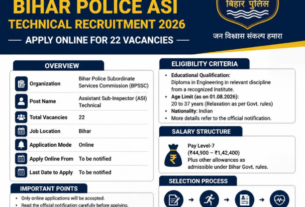
The Government of Bihar has stepped up its public employment drives, unveiling a massive recruitment calendar aimed at filling roughly 1.95 lakh vacant positions across critical administrative, public safety, health, and educational wings. For government job aspirants, these developments represent a rare, golden window of opportunity to enter highly stable, prestigious, and socially rewarding public service positions.
Landing a seat in these state competitive exams requires a granular understanding of the specific roles and targeted, methodical preparation. This guide breaks down the latest major recruitment sectors announced by the state, analyzing the core job descriptions, exact examination metrics, and actionable preparation blueprints to help you ace these state-level exams.
1. Top Elite & Executive Services (BPSC 72nd CCE)
The Bihar Public Service Commission (BPSC) conducts the annual Combined Competitive Examination (CCE) to recruit for top-tier Group A and Group B civil administrative positions within the state.
Exhaustive Job Descriptions
-
Sub-Divisional Officer (SDO) / Senior Deputy Collector: Functioning within the coveted Bihar Administrative Service (BAS), these officials lead administrative blocks or sub-divisions. SDOs are responsible for maintaining public order, managing regional land revenue machinery, overseeing the local execution of rural development programs, and acting as a vital point-of-contact during local crises or election seasons.
-
Deputy Superintendent of Police (DSP): Belonging to the police wing, DSPs manage specific law enforcement subdivisions. They supervise local police stations, strategize crime prevention mechanisms, control crowds during major festivals, coordinate criminal investigations, and maintain overall law and order within their jurisdictions.
-
Revenue Officer: Stationed within the Bihar Revenue Service, these officers process land registration titles, assess agrarian tax outlays, settle boundary disputes, maintain digitized mutation land maps, and execute land acquisition frameworks for regional infrastructure projects.
-
Block Panchayat Raj Officer (BPRO): Functioning under the Panchayati Raj framework, BPROs monitor rural infrastructure spending. They verify funds disbursed to local Gram Panchayats, evaluate regional sanitation and water connectivity assets, and audit rural developmental expenditures.
Examination Details
The BPSC uses a strict three-tier assessment structure:
-
Preliminary Test: A single, 2-hour OMR sheet exam consisting of 150 objective-type questions with a 1/3rd negative marking penalty for every incorrect answer.
-
Mains Examination: A descriptive written test including a qualifying paper in General Hindi (30% mandatory threshold), General Studies I (300 marks), General Studies II (300 marks), and an Essay paper (300 marks). A 100-mark objective optional paper is also taken on a qualifying basis.
-
Interview Stage: Evaluates personality traits, general awareness, and decision-making capabilities.
How to Prepare
To clear the BPSC cut-off, build a comprehensive strategy around standard civil service textbooks. Study Indian Polity using M. Laxmikanth and Indian Modern History via Spectrum publications. Pay heavy attention to the history and geography of Bihar using regional books like KBC Nano’s Bihar Samagra. Track state economic metrics by analyzing the latest Bihar Economic Survey and state budget outlays issued by the finance department. For the descriptive Mains segment, practice writing 2–3 answers daily, keeping your conclusions analytical, clear, and focused on current societal developments.
2. White-Collar Administrative Cadres (BSSC Inter-Level)
The Bihar Staff Selection Commission (BSSC) manages clerical and operational desk roles across various state directorates, high court wings, and regional collectorates.
Exhaustive Job Descriptions
-
Panchayat Secretary: Acting as the primary executive coordinator for rural blocks, they manage files for local development, handle documentation for state scholarship distributions, record village birth and death registries, and work closely with local elected leaders to execute state-sponsored welfare programs.
-
Revenue Employee (Rajasva Karmachari): Placed within the land reforms department, these employees calculate local agricultural valuations, register deeds, process land mutation certificates, and verify land ownership profiles for rural citizens.
-
Lower Division Clerk (LDC): Stationed across central state secretariat complexes and regional administrative offices. LDCs process letters, update internal state computer networks, archive old physical records, and prepare executive notes for higher bureaucrats.
Examination Details
The BSSC selection path relies on a multi-tiered written approach:
-
Prelims Written Test: Consists of 150 objective multiple-choice questions focusing on General Studies, General Science, Mathematics, and Logical Reasoning/Mental Ability.
-
Mains Written Test: A deeper objective evaluation testing advanced reasoning and state governance structures.
-
Skill Test: Clerical roles require passing a practical typing test (Hindi and English speed around 25/30 words per minute), while steno roles test shorthand dictation.
How to Prepare
Since nearly 30% to 40% of the entire written question booklet covers analytical patterns, make verbal and non-verbal reasoning your primary focus. Dedicate daily practice time to topics like coding-decoding, blood relations, and pattern completion. Revise high-school level mathematics and science concepts based on state board textbooks.
Important Tip: Do not wait until your written results are out to start practicing your computer typing skills. Dedicate 20 to 30 minutes to consistent, correct-posture keyboard practice every single day to clear the mandatory typing skill threshold smoothly.
3. Public Safety & Uniform Personnel (CSBC Bihar Police)
The Central Selection Board of Constables (CSBC) manages mass recruitment campaigns to maintain public safety, auxiliary civil defense lines, and state forestry borders.
Exhaustive Job Descriptions
-
Bihar Police Constable: Serving as the direct law enforcement line on the street, constables maintain active area patrols, assist senior sub-inspectors in securing crime scenes, manage public traffic networks, guard critical public property, and manage local crowd configurations during large protests or public rallies.
-
Driver Constable: Tasked with operating state emergency response vehicles, transport trucks, and police vans safely during high-speed emergency runs or remote operations. Driver constables are also responsible for managing basic daily mechanical maintenance on their assigned vehicles.
-
Forest Guard / Excise Constable: Stationed in eco-sensitive wildlife zones or borders, these officers prevent illegal logging, stop wildlife smuggling, track down contraband networks, check vehicles at borders for illicit transport, and protect natural assets.
Examination Details
The CSBC screening relies on a balance of written knowledge and physical endurance:
-
Qualifying Written Test: An OMR-based test containing 100 objective questions covering Matriculation-level History, Science, Math, and basic Hindi grammar. This round serves strictly as a qualifying filter.
-
Physical Efficiency Test (PET): The core tier that determines final merit standing. It scores candidates based on their performance in a 1.6 km timed run, a high jump, and a shot-put distance throw.
How to Prepare
The written section matches standard Class 9 and 10 state board textbooks. Focus on basic general knowledge, standard physics and biology definitions, and straightforward arithmetic.
To score high on the physical exam, establish a structured physical training routine early on. Build up your cardiorespiratory stamina by practicing long-distance running 4 to 5 mornings a week, and mix in specific training sessions for shot-put throwing techniques and high-jump mechanics.
Action Plan for Aspirants
| Step | Goal | Key Daily Focus |
| Step 1 | Foundation Building | Read through standard Class 9–12 state board textbooks for core science and social study fundamentals. |
| Step 2 | State-Specific GK | Study regional books to learn about Bihar’s history, local river channels, and ongoing welfare schemes. |
| Step 3 | Skill & Speed | Spend time practicing analytical reasoning questions and building consistent computer typing speed. |
| Step 4 | Mock Reviews | Take 2 timed mock tests each week, evaluate your errors carefully, and revise your weak areas. |
By taking a structured approach, aligning your studies with the latest exam patterns, and remaining consistent across both written and skill-based stages, you can confidently turn these massive recruitment opportunities into a secure public sector career.