
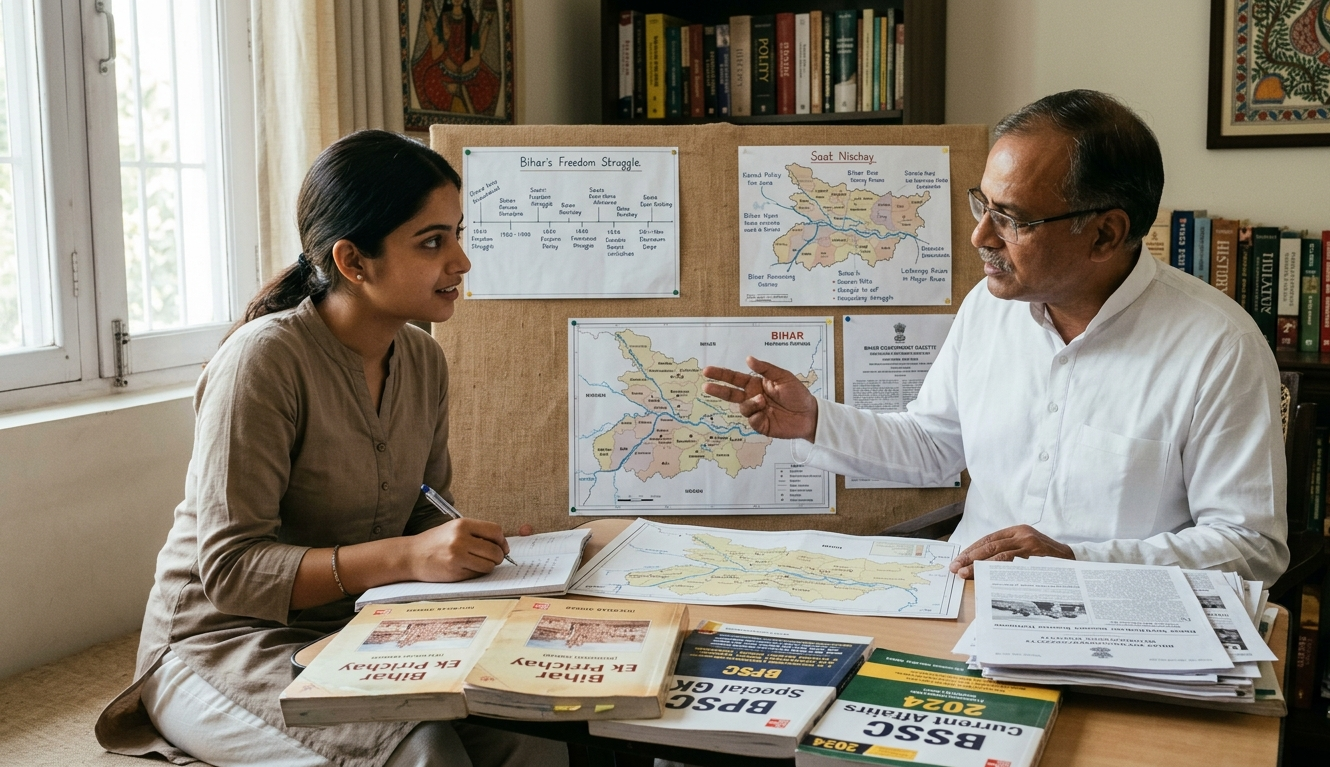
Cracking any competitive examination organized by the Bihar government requires a deeply strategic approach to regional knowledge. Whether you are appearing for the Bihar Public Service Commission (BPSC) Combined Competitive Examination, the Bihar Staff Selection Commission (BSSC) graduate and intermediate level drives, or the Bihar Police Subordinate Services Commission (BPSSC) recruitment phases, one subject serves as the ultimate tie-breaker: Bihar Special General Knowledge (GK) and State Current Affairs.
Many aspirants spend months mastering global history or national economics while neglecting the regional syllabus. However, a closer look at exam trends reveals that regional questions make up a massive chunk of the general studies papers. Scoring high in this section requires moving past generic multiple-choice questions and focusing on the core conceptual history, geography, and changing economic framework of the state. This comprehensive guide outlines the exact preparation blueprint you need to master Bihar GK and also check out the blueprint for Mental Ability and Reasoning and secure your spot on the final merit list.
| Exam Category | Average Number of Regional Questions | Core Focus Areas to Prioritize |
| BPSC Prelims (GS Paper) | 20 to 25 Questions out of 150 | Modern Freedom Struggle, Economic Survey, Saat Nischay Scheme |
| BSSC Inter/Graduate Level | 12 to 15 Questions out of 150 | Bihar Geography, River Systems, Local Mineral Distribution |
| Bihar Police & Daroga Exams | 10 to 12 Questions out of 100 | Demographic Census Data, Ancient History, State Welfare Schemes |
1. The Historical Framework: Ancient Roots to Modern Movements
Bihar’s history is not just a regional subject; it forms the bedrock of ancient Indian history. State exam boards frequently test candidates on specific historical events that unfolded within the geographical boundaries of Bihar. When planning your study routine, divide the historical timeline into three major blocks.
Ancient History Focus Areas
The ancient history of Bihar is dominated by the rise of powerful empires and spiritual movements. You must focus extensively on the Magadha Empire, tracking its evolution from the Haryanka dynasty down to the Mauryas and the Guptas. Pay close attention to administrative structures, capital shifts between Rajgir (Rajgriha) and Patna (Pataliputra), and the economic policies of these eras. Furthermore, Bihar is the birthplace of Buddhism and Jainism. Expect recurring questions regarding the specific locations of Buddhist Councils, royal patrons, and the life of Vardhamana Mahavira and Gautama Buddha.
Medieval History Focus Areas
During the medieval phase, the focus shifts toward local chieftains and the prominent rule of Sher Shah Suri. You need to study his administrative reforms, the introduction of the Rupiya currency, and the construction of the Grand Trunk Road. Additionally, understand the structural impact of the Delhi Sultanate and the Mughal Empire on the regional subas (provinces) of Bihar.
Modern History and Freedom Struggle
This is the highest-yielding sub-section within history. Review boards consistently test candidates on Bihar’s active participation in throwing off colonial rule. Master the details of the Champaran Satyagraha of 1917, including the roles of local leaders like Raj Kumar Shukla who invited Mahatma Gandhi to the region. Ensure you thoroughly research the 1857 revolt under the leadership of Babu Kunwar Singh of Jagdishpur. Moving forward in the timeline, study the Kisan Sabha movements led by Swami Sahajanand Saraswati, the Bihar Socialist Party formations, and the impact of the Quit India Movement of 1942, specifically highlighting the local underground resistance forces.
2. Bihar Geography: Rivers, Soils, and Climate Patterns
Geographical questions in Bihar state exams are highly analytical. Memorizing a map is no longer sufficient; you must understand the environmental mechanics and economic impacts of the state’s topography.
The Dynamic River System
The Ganga River flows from west to east, splitting Bihar into two distinct geographic zones: North Bihar and South Bihar. This division determines the economic and natural landscape of the region.
-
North Bihar Rivers: Rivers like the Kosi, Gandak, Burhi Gandak, and Ghaghra originate in the Himalayas. These are perennial, snow-fed rivers prone to changing courses. The Kosi is notoriously called the “Sorrow of Bihar” due to its severe annual flooding. Focus your study on flood management initiatives, embankment projects, and wetland ecology.
-
South Bihar Rivers: Rivers like the Son, Punpun, Falgu, and Kiul originate in the southern plateau regions. These are seasonal, rain-fed rivers that dry up significantly during the summer months, leading to drought conditions in the southern districts.
Soil and Mineral Distribution
Understanding soil distribution is critical because it ties directly into the state’s agrarian economy. Study the location of Terai soils along the Nepal border, the vast alluvial plains (Bangar and Khadar) covering central Bihar, and the older, red-yellow plateau soils in the far south. When studying mineral resources, remember that since the bifurcation of Bihar and Jharkhand, major mineral fields went south. However, you must track Bihar’s remaining mineral deposits, such as pyrite in Rohtas, mica in Nawada, and bauxite and quartzites in the Munger region.
3. Demographics and Census Data: The Statistical Advantage
Data sets from demographic surveys are low-hanging fruit for aspirants. Government exams regularly feature direct, factual questions concerning state statistics. You must have the following core metrics memorized, along with the highest and lowest ranking districts for each category:
-
Population Density: Bihar ranks at the top nationally for population density. You must know the exact figures and identify why districts like Sheohar show extreme density numbers.
-
Literacy Rates: Break down the overall literacy rate, male literacy, and female literacy. Track the impressive growth rates in districts like Rohtas and identify regions requiring deeper educational intervention.
-
Sex Ratio: Study both the overall sex ratio and the child sex ratio, identifying top-performing districts like Gopalganj.
4. Current State Policies, Economic Surveys, and Budgets
To clear state exams today, you cannot rely entirely on static textbooks. Modern test frameworks prioritize current socio-economic initiatives. A massive portion of your general current affairs preparation must be dedicated to analyzing official state reports.
The Bihar Economic Survey and State Budget
Do not try to read these multi-hundred-page government documents line by line. Instead, focus on the summary chapters. Extract the state’s Gross State Domestic Product (GSDP) growth rate, sector-wise growth contributions (Primary, Secondary, and Tertiary sectors), and total fiscal deficit percentages. Pay close attention to allocations toward infrastructure, rural development, and education.
Major Welfare Schemes
Questions about state welfare programs appear frequently in preliminary and main rounds alike. Ensure you have complete clarity on the phases of the Saat Nischay Yojana (Seven Resolves) launched by the state government. You should understand the primary goals of initiatives covering youth empowerment, clean drinking water access, electricity connections, and women’s self-reliance. Additionally, track agricultural initiatives like the Krishi Road Maps, which aim to modernize farming techniques, boost crop diversification, and improve irrigation access across drought-prone zones.
Frequently Asked Questions (FAQs)
Which book is best for Bihar Special GK preparation?
For comprehensive coverage, standard reference books like ‘Bihar Ek Parichaya’ by Imtiaz Ahmad (available in Hindi) or ‘Bihar General Knowledge’ by Dr. Manish Ranjan (Crown Publications) are highly recommended. Always supplement these with the latest annual Bihar Economic Survey summary.
How many questions are asked from Bihar GK in the BPSC Prelims exam?
On average, BPSC dedicates around 20 to 25 questions specifically to Bihar Special history, geography, economy, and current affairs. This makes it one of the highest-yielding sections in the General Studies paper.
What is the Saat Nischay Yojana in Bihar current affairs?
The Saat Nischay Yojana (Seven Resolves) is the Bihar government’s flagship multi-sector developmental blueprint. It focuses on seven distinct socio-economic areas, including clean drinking water, youth employment, women’s empowerment, electricity connectivity, and rural infrastructure.
Why is the study of the river systems in Bihar crucial for state exams?
The river network determines the economic, agricultural, and natural disaster landscape of the state. Questions frequently target the northern tributaries causing seasonal floods (like the Kosi) versus southern seasonal rivers, along with their entry points into Bihar.
About the Author
Sanskriti Prajapati is a professional content analyst and digital media writer who specializes in structuring educational frameworks, syllabus breakdowns, and strategic preparation roadmaps for state-level competitive examinations.


4 thoughts on “How to Master Bihar Special GK and Current Affairs for BPSC, BSSC, and State Exams”